Your website may explain your services clearly to existing customers but still leave important questions unanswered for people discovering your company for the first time. A potential customer might ask Google or an AI assistant what a particular service involves, how much it costs, whether it is suitable for their situation, or how different providers compare.
If your website does not address these questions, customers may need to look elsewhere for information. Answer Engine Optimization, commonly called AEO, is a way to make website content more useful for question-driven search and discovery.
For Finnish businesses, successful implementation requires more than adding FAQ sections or rewriting headings as questions.
At Dexora Digital, we approach AEO through customer intent, content accuracy, technical accessibility, and clear connections between educational resources and commercial service pages.
This guide explains how to evaluate an existing website and introduce AEO improvements systematically.
What Is Answer Engine Optimization?
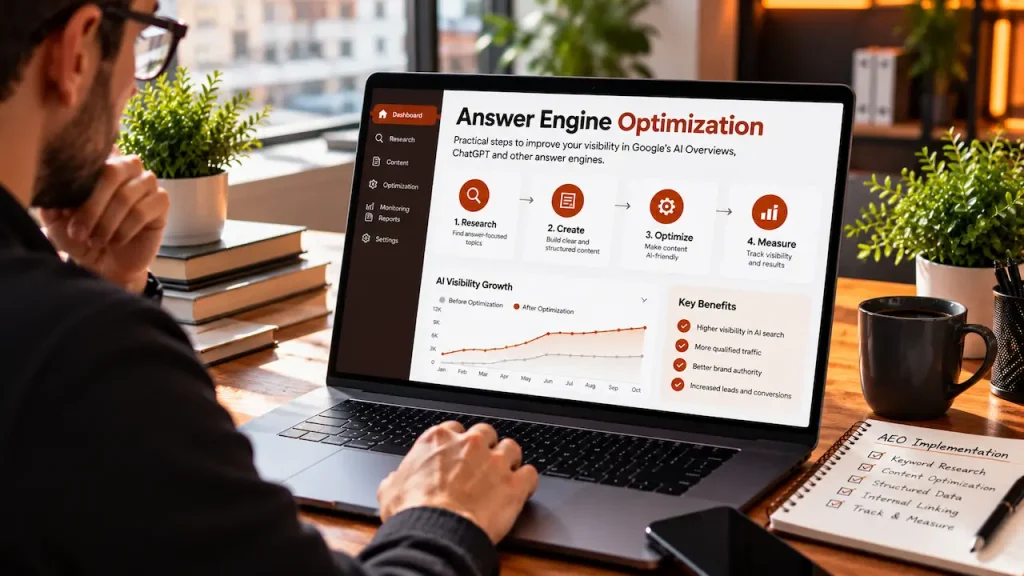
Answer Engine Optimization is the practice of organizing and improving content so that it provides clear, accurate, useful answers to relevant customer questions. It is closely related to traditional search engine optimization and may support discovery through conventional search results, answer-oriented features, and AI-assisted search experiences.
For example, an accounting firm might answer questions about bookkeeping requirements, payroll administration, and choosing an accounting provider.
A construction company might explain permit requirements, project timelines, and the differences between available services. In both cases, the objective is to help customers understand the topic and make informed decisions.
AEO does not guarantee that a particular search platform will display or quote an answer.
Our Answer Engine Optimization services in Finland address how businesses can improve the quality and organization of information available to their customers.
Start With the Questions Your Customers Actually Ask
The first stage of AEO is researching real information needs. Businesses often begin with a list of keywords and assume every phrase requires a dedicated webpage. That approach can create unnecessary duplication. A better process starts with the customer’s situation.
Review existing enquiries
Sales calls, contact forms, customer support tickets, and consultation notes frequently reveal the questions customers ask before purchasing. A website development agency might repeatedly receive questions about project costs, ownership, maintenance, and delivery timelines.
These are valuable topics because they reflect real decision-making concerns.
Examine search performance data
Google Search Console can reveal queries associated with existing pages. The data may identify information needs that current content addresses only partially.
For example, a service page may receive impressions for questions about pricing without explaining the factors that influence cost.
Improving the existing page might be more useful than publishing a separate article.
Group related questions by intent
Some questions seek definitions. Others concern pricing, comparisons, eligibility, procedures, or purchasing decisions. Grouping similar questions helps determine where answers belong.
A general definition may suit an introductory article, while a question about whether a service is right for a particular business may belong on a commercial service page.
Audit Your Existing Website Before Creating New Articles
Publishing more content is not always the correct starting point. An AEO audit should identify important questions that existing pages answer poorly or not at all. Start with the homepage and primary service pages.

Look for explanations of target customers, services, deliverables, expected processes, pricing considerations, and next steps. Then assess the supporting blog, Check whether existing articles expand on service topics or simply repeat the same introductory definitions.
Identify answer gaps
An answer gap occurs when customers need information that the website does not provide adequately.
For example, an SEO agency may explain what technical SEO is but fail to describe the situations in which a technical audit becomes necessary.
That missing information could be addressed by adding a useful section to an existing service page or creating a focused supporting article.
Find duplicate content intent
Two articles may use different wording while answering essentially the same customer question.
This can create unnecessary competition between pages and make internal linking less clear.
The goal is not to force every page to rank for a unique word.
It is to give each important page a distinct purpose within the customer journey.
Check whether claims are supported
AEO content should not present marketing claims as verified facts without evidence. If an article promises a specific result, readers should understand the relevant conditions and limitations.
Claims about regulatory compliance, financial outcomes, or technical performance may require especially careful review.
Build an Answer-Focused Content Structure
Once gaps are identified, improve the way information appears on the page.
Use descriptive headings
Headings should make it easy to understand what a section explains. A heading such as “What affects the cost of local SEO?” communicates the subject more clearly than “Our innovative solutions.”
However, not every heading needs to be a question. Use natural descriptions when they improve readability.
Give the essential answer first
A direct answer helps visitors understand the main point immediately. Further paragraphs can explain exceptions, provide evidence, and describe relevant practical considerations.
For example, when answering whether multilingual SEO is necessary in Finland, a useful response should explain that the decision depends on the company’s audiences and markets.
It can then discuss Finnish, Swedish, and English content requirements in more detail. Our multilingual SEO guide provides a useful supporting example.
Match answer depth to the question
A basic definition may need only a concise explanation. A question about implementing international website architecture may require examples, diagrams, technical details, and warnings about common mistakes. The appropriate answer length depends on what the reader needs.
Artificial word-count limits for individual answers can encourage either unnecessary filler or missing details.
Create AEO Content for Finnish Search Intent
Finland has a varied business environment, and customers may have different expectations according to industry, geography, and language. A business serving local customers in Oulu may need content about location coverage and service availability.
A technology company serving international customers may need technical information in English. A nationwide company may need Finnish-language content explaining commercial requirements across several regions.
Research language-specific questions
Do not assume that translating an English article automatically serves Finnish-speaking customers. Terminology and question patterns can differ between languages.
Research should consider how actual customers describe services in Finnish, Swedish, and English.
Include relevant local context
Geographic references should support the topic. A local SEO article may benefit from examples involving Helsinki, Tampere, or Turku. A technical guide about structured data does not need city names inserted throughout the content.
Relevant localization improves usefulness. Repeated location keywords without context add little value.
Consider industry terminology
Businesses in engineering, healthcare, finance, technology, and industrial services often use specialist terminology. Content should explain important terms accurately without oversimplifying technical requirements. Subject-matter experts should review information where incorrect advice could create meaningful risks.
Connect AEO With Technical SEO
Answer clarity is only one part of online discoverability. Search engines and other systems also need appropriate access to website content. Important pages should be reachable through ordinary navigation and internal links.
They should use appropriate canonical URLs, avoid accidental indexing restrictions, and display essential information in accessible text.
Review crawlability and indexability
If a page cannot be discovered or indexed by a relevant search engine, its content may have limited opportunities to appear through that search engine.
Check technical issues before assuming content wording is the problem.
Use structured data appropriately
Structured data can describe information using standardized formats. However, adding markup does not guarantee inclusion in AI-generated answers. Google’s AI search guidance does not require special schema to appear in AI Overviews or AI Mode.
Structured data should accurately match the visible content and comply with the requirements of its intended search features.
Improve internal navigation
Related pages should connect through useful, descriptive anchors. An article explaining site indexing might link to a detailed technical SEO resource and the relevant service page.
Our technical SEO services address these underlying website requirements.
Build Topic Clusters Without Creating Cannibalization
A topic cluster connects a primary commercial or comprehensive resource with supporting content. For an SEO agency, the primary page might describe technical SEO services. Supporting articles could examine crawl errors, website migrations, indexing problems, and interpreting audit results. Each page should address a distinct need.
Choose one clear destination for commercial intent
A buyer looking for a service should have an obvious page where they can understand the offering and enquire. Blog posts should support that destination instead of repeating the entire service pitch.
Link related resources naturally
Contextual internal links help users move from introductory explanations to deeper guidance. They also help establish relationships between relevant pages.
Our article explaining SEO, AEO, and GEO provides the broader conceptual comparison for readers deciding which discipline they need to understand.
Update existing content before adding duplicates
If a current article already covers most of a proposed topic, improving the original is often preferable to creating another introductory guide.
This is especially important for foundational topics where the website already has suitable pages.
Use Evidence to Improve Answer Quality
Useful answers are not limited to definitions and general explanations. Customers may need proof that a provider understands the issue. Evidence can include project examples, documented processes, original observations, appropriate research references, and professional experience.
A case study is particularly helpful when it explains the challenge, work completed, measurement approach, and outcomes. For businesses researching AI-related visibility, our Keentel Engineering case study offers an example of how a specialist project is presented.
Case studies should not imply that one project’s outcome is guaranteed for every client. Evidence should clarify expectations rather than create unrealistic promises.
How to Measure an AEO Strategy
AEO measurement should begin with outcomes relevant to the business. Track whether visitors can find important information, whether useful pages receive relevant search traffic, and whether the website generates qualified enquiries.
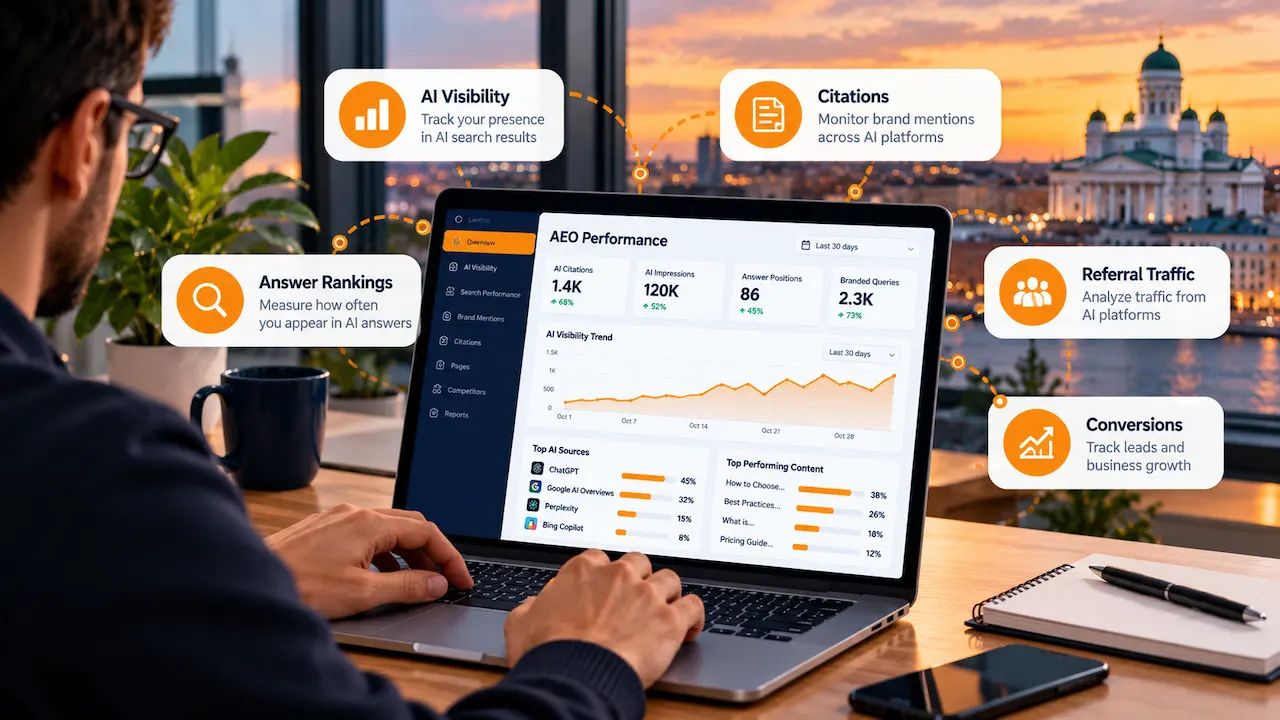
For AI-related monitoring, define a set of questions associated with the company’s services and target customers.
Review the responses periodically and record relevant appearances or citations where observable.
Compare consistent question sets
Using different questions every month makes comparisons difficult. A stable evaluation set gives the business a more useful reference point. Additional questions can be added when services or customer needs change.
Review factual representation
Visibility alone is not enough. If an AI-generated response mentions a business but describes its services incorrectly, that is a different outcome from an accurate and relevant mention.
Document meaningful inaccuracies and examine whether the company’s own published information is clear and current.
Connect findings with business performance
Organic conversions, consultation bookings, qualified leads, and customer feedback remain essential.
Our AI visibility monitoring services can help businesses review discoverability beyond individual ranking reports.
Common AEO Mistakes Finnish Businesses Should Avoid
A common mistake is creating hundreds of questions without checking whether customers genuinely ask them. Another is publishing answers that merely repeat promotional claims. Some businesses also expect FAQ markup to produce automatic AI citations, even though search platforms provide no such guarantee.
A further mistake is copying general advice without accounting for Finnish language requirements, local services, or specialist industries.
Finally, AEO should not become a reason to neglect website performance, technical accessibility, and conversion quality. The best improvements support the overall customer experience.
A Practical 30-Day AEO Implementation Plan
During the first week, identify the business’s most important customer questions. Review sales enquiries, search data, and primary service pages.
In the second week, audit existing content and group questions according to intent. Identify pages needing updates and topics requiring new resources.
During the third week, improve high-priority content. Add clear explanations, supporting evidence, useful headings, and appropriate internal links.
In the fourth week, verify technical accessibility and establish baseline measurements. Define a repeatable review process for both search performance and relevant AI-assisted discovery.
This schedule is a planning example rather than a guaranteed implementation timeline. Larger websites may require more extensive work.
Frequently Asked Questions
Is AEO relevant for small businesses in Finland?
Yes. Small businesses can benefit from answering customer questions clearly, particularly those involving services, locations, processes, and purchasing decisions.
Is AEO different from content marketing?
AEO focuses specifically on making information useful for answer-oriented discovery. Content marketing has a broader scope that may include education, brand development, customer acquisition, and retention.
Does every website need an FAQ section?
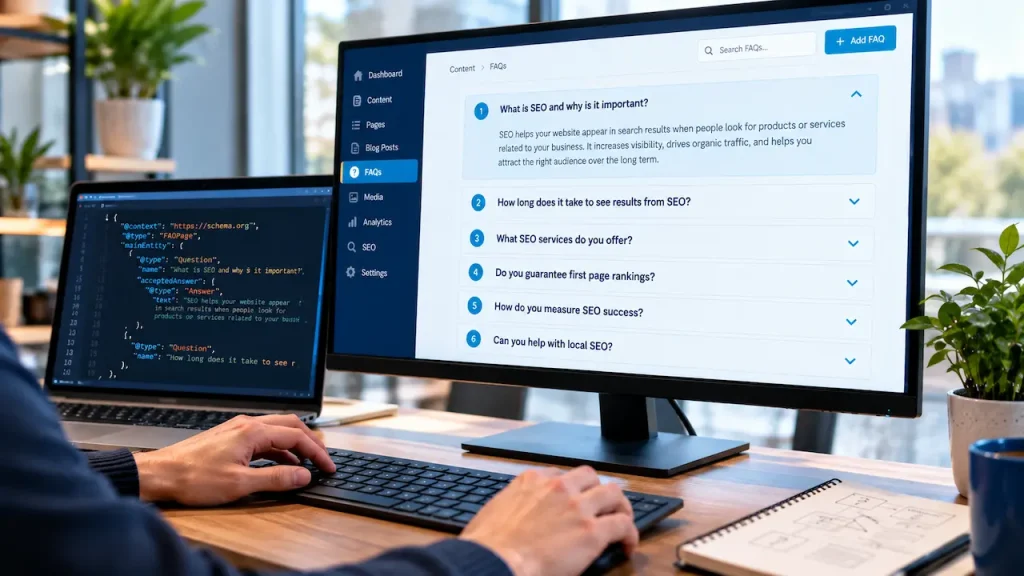
No. FAQs should be included when they address relevant questions that are not already answered adequately elsewhere on the page.
Can AEO improve ChatGPT visibility?
Clear, accessible and credible content may support discoverability in various environments, but there is no guarantee that an AI system will select or recommend a particular website.
How often should AEO content be updated?
Review content when facts, services, regulations, products, or platform requirements change. High-impact and time-sensitive information may need more frequent review.
Make Your Website More Useful to Customers and Search Systems
Answer Engine Optimization begins with understanding what customers need to know. Businesses that answer those questions accurately, organize their information clearly, maintain technical accessibility, and support claims with evidence create a stronger foundation for digital discovery.
For Finnish companies, the next step is to apply these principles to the right languages, services, industries, and customer journeys.
At Dexora Digital, we help businesses combine SEO, AEO, and AI visibility improvements into a practical strategy.
Request your free AI and SEO audit to identify where your website could provide clearer answers and better support customer discovery.